


 New Cars
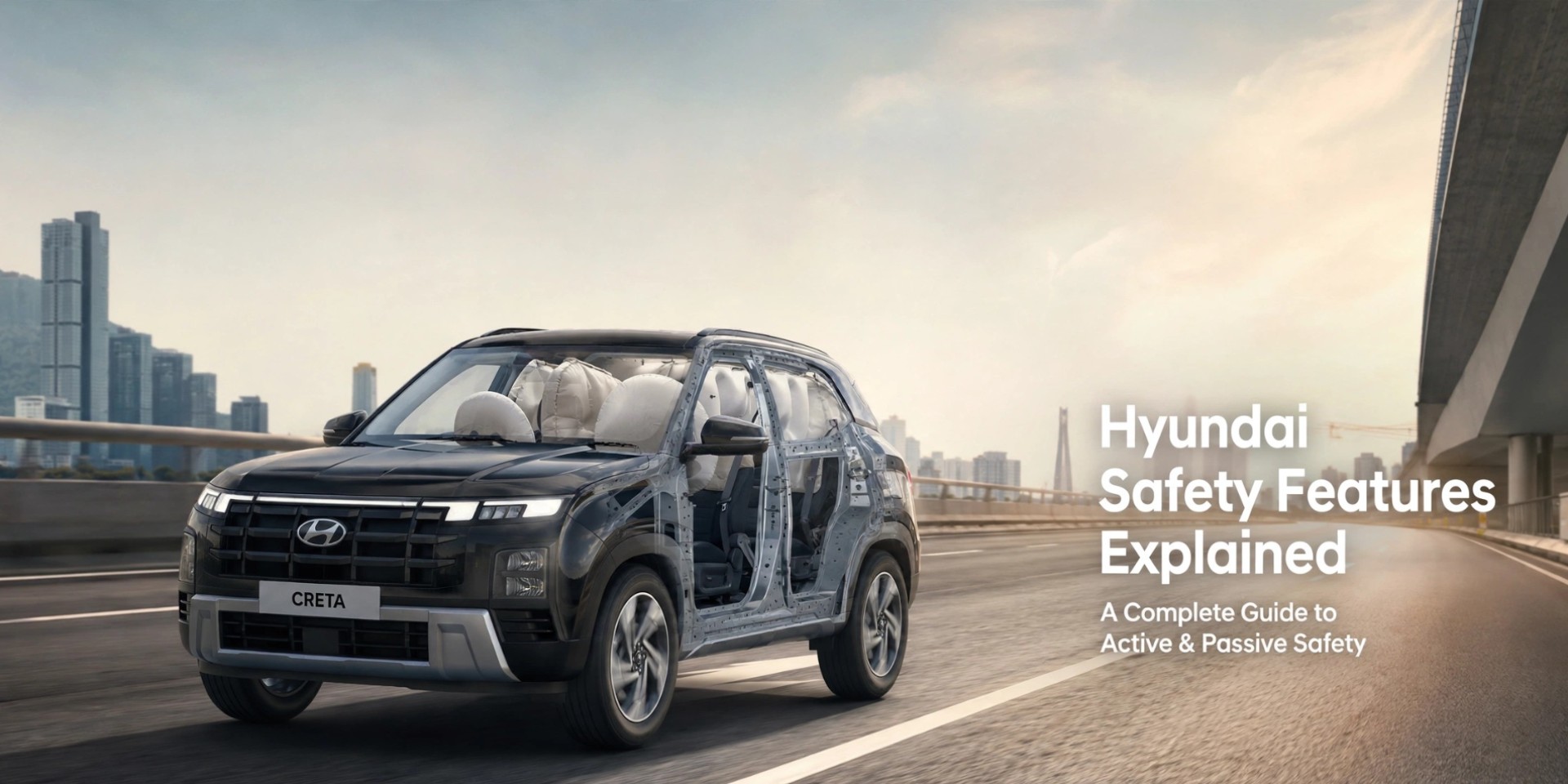
Hyundai Safety Features Explained: Complete Guide (2026)
Explore Hyundai's complete safety suite — airbags, ESC, ABS with EBD, ADAS & more. Learn how passive and active safety features protect you on Indian roads.
Quick Answer
Hyundai cars in India come equipped with a layered safety system that includes passive features like airbags and a high-strength steel body, and active features like Electronic Stability Control, ABS with EBD, and Hill-Start Assist. Higher variants add ADAS-based active safety technology. Together, these features are designed to prevent accidents where possible and minimize injury when a collision does happen.
Passive vs. Active Safety: What's the Difference?
Passive safety features protect occupants during a crash — airbags, seatbelts, crumple zones, and body structure.
Active safety features help prevent a crash from happening - ABS, ESC, traction control, and ADAS.
A genuinely safe car needs both working together, not just a high airbag count.
Core Hyundai Safety Features
1. Multiple Airbags (Up to 6)
Front, side, and curtain airbags protect the head, chest, and torso of both front and rear passengers during a collision.
2. Electronic Stability Control (ESC)
Automatically applies braking force to individual wheels if the car begins to skid or lose traction, helping the driver maintain control during sudden maneuvers.
3. ABS with Electronic Brakedistribution (EBD)
Prevents wheels from locking up during hard braking, allowing the driver to steer while braking instead of skidding in a straight line.
4. Hill-Start Assist Control (HAC)
Holds the brake momentarily on an incline, preventing the car from rolling backward when moving from brake to accelerator.
5. Vehicle Stability Management (VSM)
An advanced version of ESC that also factors in steering input to correct oversteer or understeer more precisely.
6. High-Strength Steel Body Structure
Hyundai uses Advanced High-Strength Steel (AHSS) in key structural zones to absorb and redirect crash energy away from the cabin.
7. ISOFIX Child Seat Anchors
Standardized mounting points in the rear seats for secure child seat installation without relying on seatbelts alone.
8. Tire Pressure Monitoring System (TPMS)
Alerts the driver in real time if tire pressure drops below a safe level, reducing blowout risk.
9. Rear Parking Sensors and Camera
Mandatory on all new cars in India, these assist with low-speed maneuvering and reduce reversing accidents.
10. Three-Point Seatbelts for All Passengers
Including the middle rear seat in most Hyundai models, with pre-tensioners and load limiters on front seats.
How These Features Work Together in a Real Scenario
Imagine a sudden obstacle appears on a highway. ESC helps the driver avoid losing control while swerving, ABS lets them brake and steer simultaneously, and if a collision is unavoidable, the airbags and reinforced body structure work together to protect occupants. This layered approach is the foundation of modern car safety engineering.
Frequently Asked Questions
Q: Do all Hyundai models come with 6 airbags?
A: Airbag count varies by model and variant — some Hyundai models offer 6 airbags as standard across all trims, while others offer it only on higher variants.
Q: What is the difference between ESC and ABS?
A: ABS prevents wheel lock-up during braking, while ESC prevents the car from skidding sideways during sharp turns or sudden maneuvers — they work together but solve different problems.
Q: Are Hyundai cars crash-tested in India?
A: Many Hyundai models sold in India have been independently tested by Global NCAP or Bharat NCAP, and results are publicly available for each model.
Q: Is ESC available on entry-level Hyundai variants?
A: ESC availability depends on the specific model and variant; it's increasingly being offered as standard due to regulatory push, but it's best to confirm with your specific trim.
Final Thoughts
Understanding the difference between passive and active safety features helps you make a more informed decision beyond just the airbag count on the brochure. When comparing variants, check which of these features come standard versus optional on your shortlisted Hyundai model.
- Quick Answer
- Passive vs. Active Safety: What's the Difference?
- Core Hyundai Safety Features
- 1. Multiple Airbags (Up to 6)
- 2. Electronic Stability Control (ESC)
- 3. ABS with Electronic Brakedistribution (EBD)
- 4. Hill-Start Assist Control (HAC)
- 5. Vehicle Stability Management (VSM)
- 6. High-Strength Steel Body Structure
- 7. ISOFIX Child Seat Anchors
- 8. Tire Pressure Monitoring System (TPMS)
- 9. Rear Parking Sensors and Camera
- 10. Three-Point Seatbelts for All Passengers
- How These Features Work Together in a Real Scenario
- Frequently Asked Questions
- Q: Do all Hyundai models come with 6 airbags?
- Q: What is the difference between ESC and ABS?
- Q: Are Hyundai cars crash-tested in India?
- Q: Is ESC available on entry-level Hyundai variants?
- Final Thoughts

21 August 2026