


 New Cars
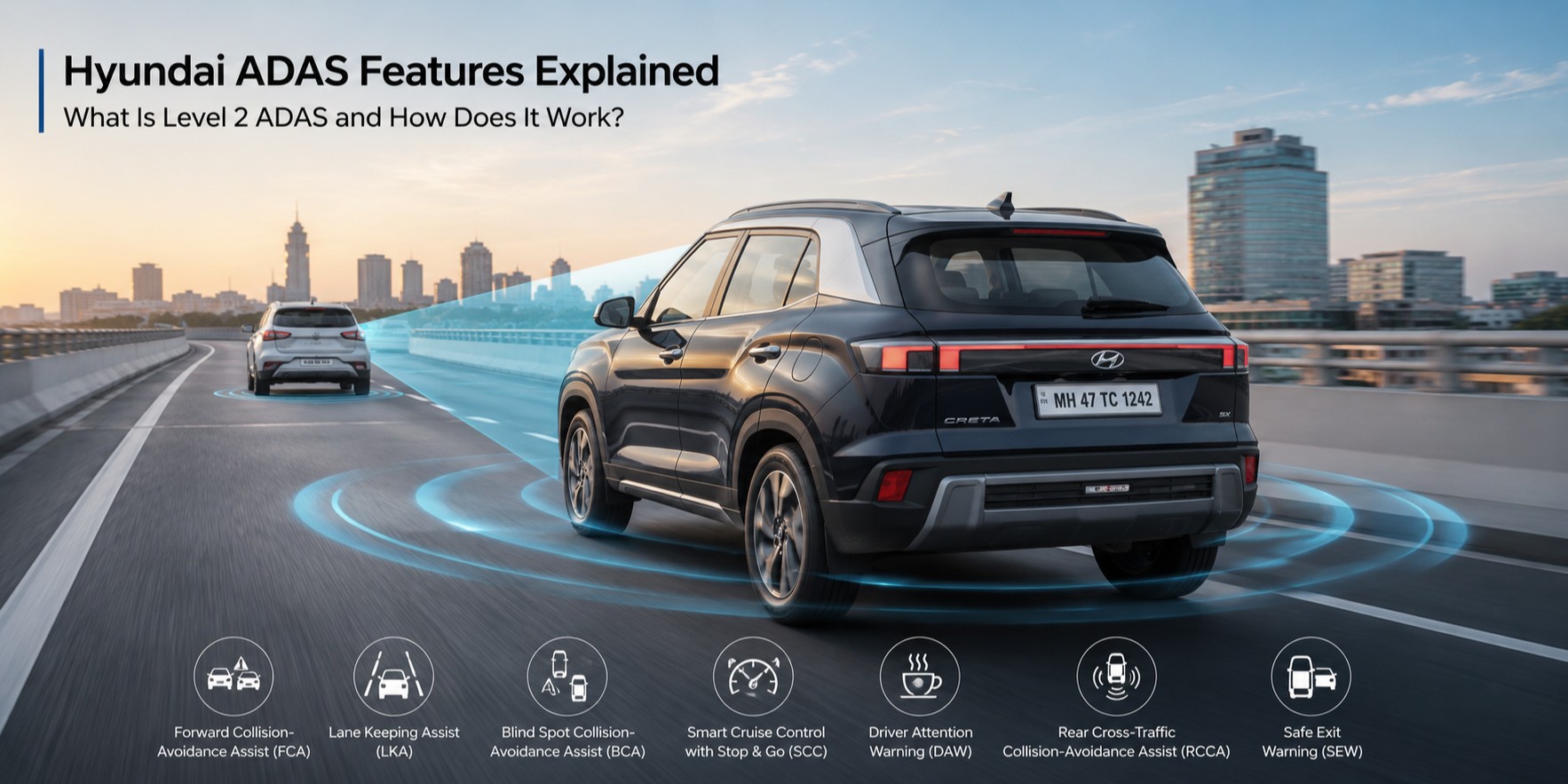
Hyundai ADAS Explained: Level 2 Features, Benefits & How It Works
Learn how Hyundai ADAS works, including Level 2 features like FCA, LKA, BCA, SCC and HDA. See how ADAS improves safety on Indian roads.
Quick Answer
Hyundai's ADAS (Advanced Driver Assistance Systems) is a suite of Level 2 driver-assist technologies that use cameras and radar sensors to detect road conditions, warn drivers of potential hazards, and, in some cases, apply automatic corrections like braking or steering nudges. Hyundai currently offers up to 10-19 ADAS features across models like Creta, Verna, and Alcazar, depending on variant and trim.
What Does ADAS Actually Mean?
ADAS stands for Advanced Driver Assistance Systems. It is not self-driving technology - it's a support system that assists the driver by monitoring the road ahead, the car's position within a lane, and nearby vehicles, then alerting or intervening when it detects risk. Hyundai's ADAS is classified as "Level 2," meaning the car can control both steering and acceleration/braking simultaneously under driver supervision, but the driver must stay attentive at all times.
Key Hyundai ADAS Features Explained
Forward Collision-Avoidance Assist (FCA)
Uses a front radar and camera to detect vehicles, pedestrians, or cyclists ahead. If a collision risk is detected and the driver doesn't react, the system can apply automatic emergency braking.
Lane Keeping Assist (LKA) and Lane Following Assist (LFA)
LKA gently corrects steering if the car drifts out of its lane without indicating. LFA goes a step further, continuously centering the car within the lane on highways.
Blind Spot Collision-Avoidance Assist (BCA)
Monitors the blind spot zones on both sides of the car. If you indicate to change lanes while a vehicle is in your blind spot, it warns you and can apply corrective braking.
Smart Cruise Control with Stop & Go (SCC)
Maintains a set speed and distance from the car ahead automatically, slowing down or speeding up in traffic - including full stops in stop-and-go conditions.
Driver Attention Warning (DAW)
Monitors driving patterns for signs of fatigue or distraction and alerts the driver to take a break.
Rear Cross-Traffic Collision-Avoidance Assist (RCCA)
Detects vehicles approaching from the sides while reversing out of a parking spot, especially useful in blind parking situations.
Safe Exit Warning (SEW)
Warns rear-seat passengers not to open the door if a vehicle or two-wheeler is approaching from behind.
Highway Driving Assist (HDA)
Combines smart cruise control and lane following to semi-automate highway driving between marked lanes.
Why ADAS Matters on Indian Roads
Indian traffic conditions - unpredictable lane discipline, sudden pedestrian crossings, and mixed-speed vehicles - make driver-assist systems especially valuable. ADAS doesn't replace attentive driving, but it acts as a second layer of protection during a momentary lapse.
Frequently Asked Questions
Q: Is Hyundai ADAS the same as self-driving?
A: No. Hyundai's ADAS is Level 2 assistance, meaning the driver must remain in control and alert at all times - it does not make the car autonomous.
Q: Which Hyundai cars come with ADAS in India?
A: Hyundai offers ADAS on select variants of models such as Creta, Verna, Alcazar, and Tucson, with the number of features varying by trim level.
Q: Does ADAS work well in heavy Indian traffic?
A: ADAS features like forward collision warning and blind spot monitoring work effectively in traffic, though features like lane following assist perform best on well-marked highways.
Q: Can ADAS be turned off?
A: Yes, most ADAS features can be toggled on or off individually through the car's settings menu, based on driver preference.
Final Thoughts
Hyundai's ADAS suite brings advanced, radar-and-camera-based safety technology that was once limited to luxury cars into the mass market. If safety is a priority in your next purchase, checking which ADAS features are standard on your shortlisted variant is a smart step before you buy.
- Quick Answer
- What Does ADAS Actually Mean?
- Key Hyundai ADAS Features Explained
- Forward Collision-Avoidance Assist (FCA)
- Lane Keeping Assist (LKA) and Lane Following Assist (LFA)
- Blind Spot Collision-Avoidance Assist (BCA)
- Smart Cruise Control with Stop & Go (SCC)
- Driver Attention Warning (DAW)
- Rear Cross-Traffic Collision-Avoidance Assist (RCCA)
- Safe Exit Warning (SEW)
- Highway Driving Assist (HDA)
- Why ADAS Matters on Indian Roads
- Frequently Asked Questions
- Q: Is Hyundai ADAS the same as self-driving?
- Q: Which Hyundai cars come with ADAS in India?
- Q: Does ADAS work well in heavy Indian traffic?
- Q: Can ADAS be turned off?
- Final Thoughts

29 August 2026